

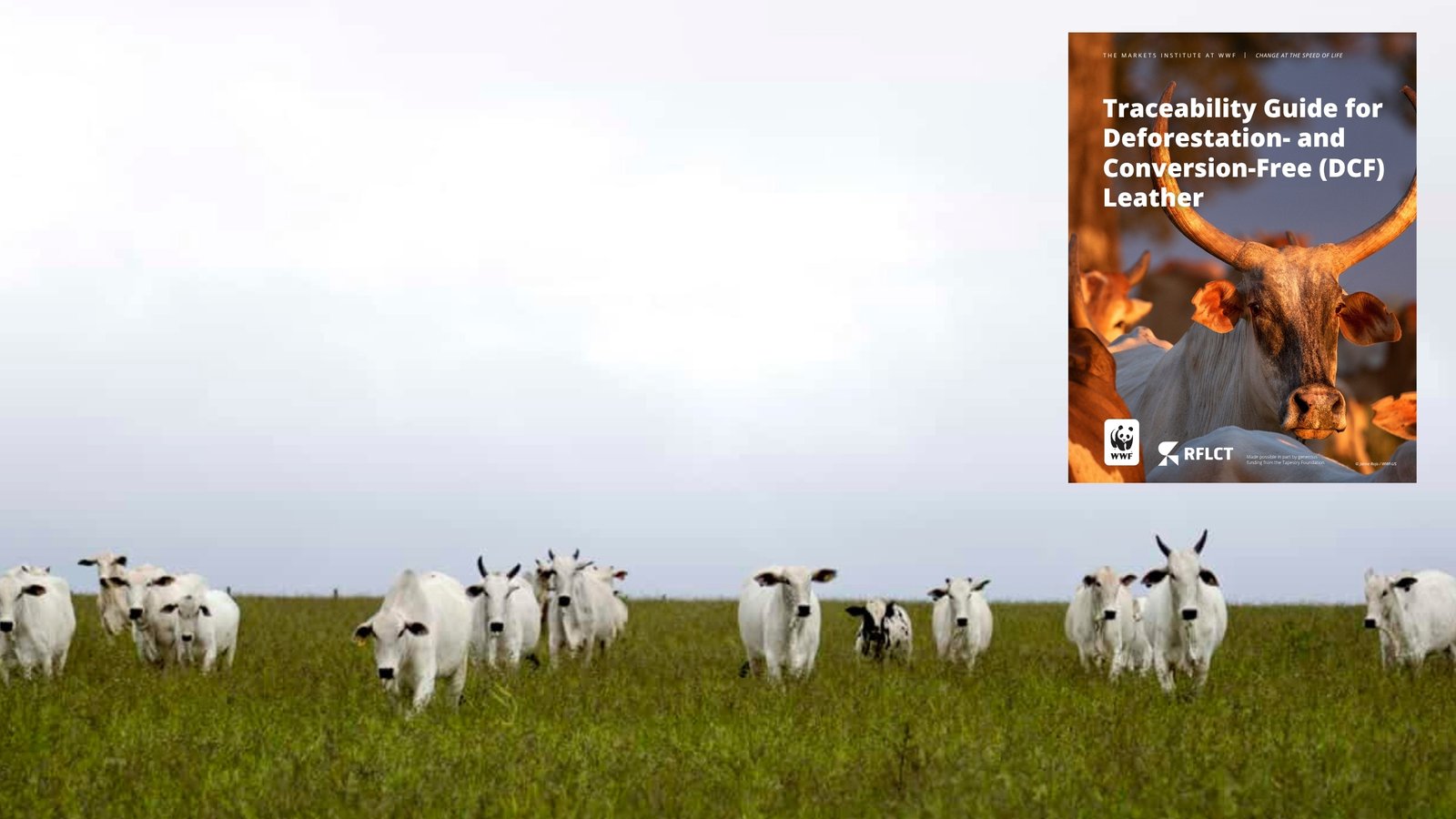
World Wildlife Fund (WWF) has partnered with Leather Working Group (LWG) and others to launch a new traceability guide to help companies build transparent and deforestation and conversion free leather supply chains. The guide supports compliance with global regulations including the EU Deforestation Regulation.
The guide provides a practical roadmap for companies to achieve full traceability across leather supply chains. It focuses on improving visibility from raw material sourcing to finished products, helping companies address risks linked to deforestation and ecosystem conversion.
The guide, developed with support from the Tapestry Foundation and the Gordon and Betty Moore Foundation, focuses on solving one of the global leather sector’s challenges, tracing hides back to their origin.
Leather, a byproduct of meat production, remains closely linked to deforestation risks in regions like Latin America where cattle ranching drives forest loss according to WWF.
The resource was created in collaboration with 22 fashion and automotive companies under the Deforestation-Free Call to Action for Leather. These companies together represent over $300 billion in annual revenue and have committed to sourcing verified deforestation-free leather by 2030 or earlier.
The guide offers a practical 10 step roadmap for companies to move from commitment to execution. It helps brands assess their current traceability systems, identify gaps and build end-to-end visibility across supply chains.
It also aligns with growing regulatory pressure such as the EU Deforestation Regulation, which requires companies to prove that their products are not linked to deforestation. Advances in digital tracking and geospatial tools are making such traceability more achievable.
The guide highlights that leather supply chains remain complex, often involving multiple farms, processors and countries, making origin tracking difficult but no longer impossible.
Download Traceability Guide for Deforestation- and Conversion-Free Leather