



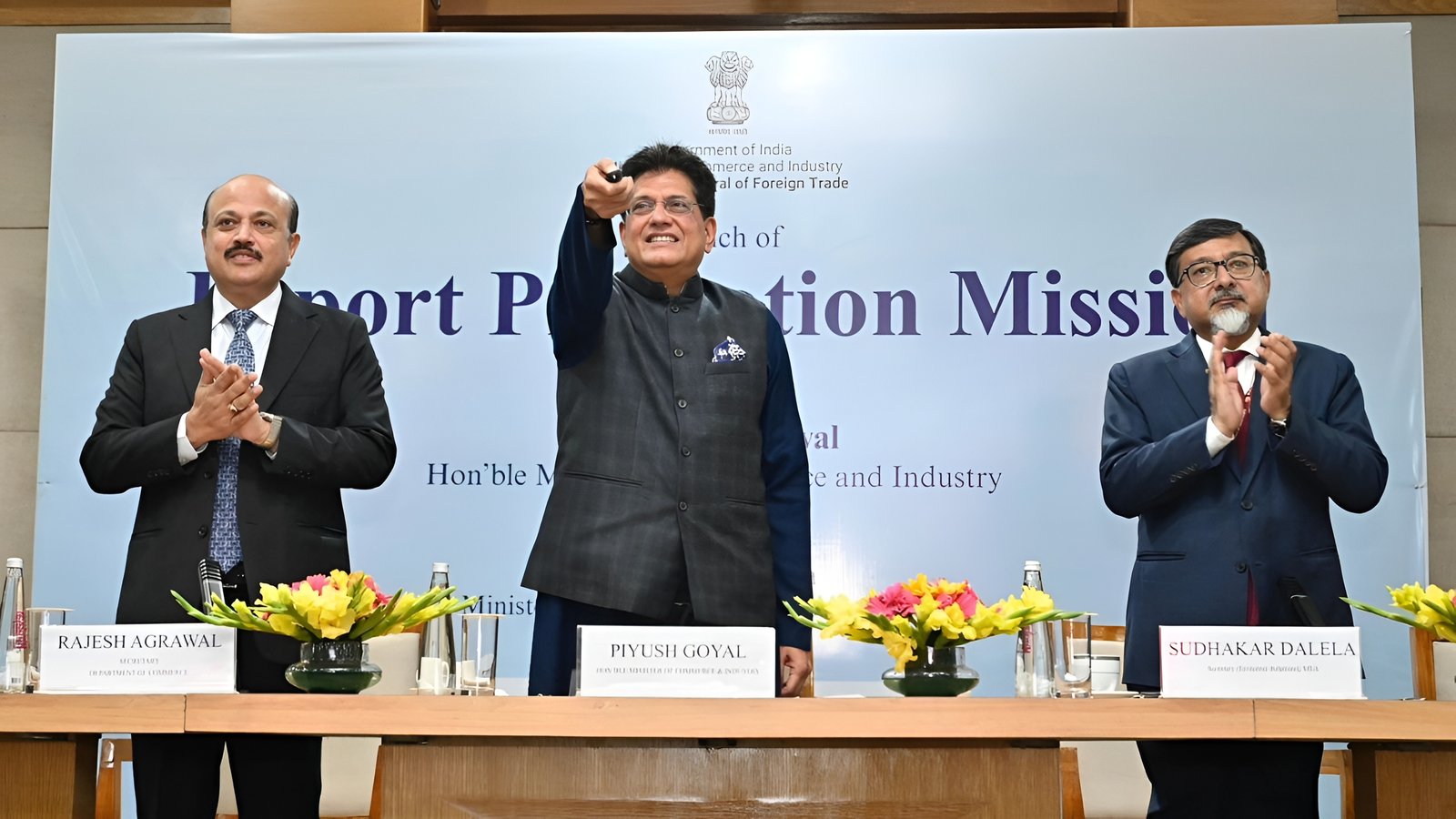
The government has launched seven new interventions under the Export Promotion Mission to help Micro Small and Medium Enterprises (MSMEs) expand into global markets.
Union Commerce and Industry Minister Piyush Goyal announced the measures on 20 February 2026, World Day of Social Justice.
The focus is clear. Make exports easier. Reduce financial pressure. Help smaller businesses compete internationally.
Speaking at the event the Minister stressed that social justice means creating opportunities for those at the bottom of the pyramid. He said growth must be inclusive and reach MSMEs startups and entrepreneurs.
He also highlighted India’s push in emerging technologies. He pointed to advancements in artificial intelligence, machine learning, quantum computing and data centres. He said these sectors will open new opportunities for India’s youth.
Referring to recent global engagements he said India is now accessing nearly 70% of global GDP through nine concluded Free Trade Agreements including the first tranche of a bilateral trade pact with the United States.
The interventions launched under Niryat Protsahan included:
1. Support for Alternative Trade Instruments (Export Factoring)
This intervention promotes export factoring as an affordable working capital solution for MSMEs. Interest subvention of 2.75% will be provided on the factoring cost for eligible transactions undertaken through RBI/IFSCA-recognised entities. Assistance is capped at ₹50 lakh per MSME annually and will be processed through a digital claim mechanism to ensure transparency and timely disbursal.
2. Credit Assistance for E-Commerce Exporters
To support exporters using digital channels, structured credit facilities are being introduced with interest subvention and partial credit guarantees. The Direct E-Commerce Credit Facility will provide support up to ₹50 lakh with 90% guarantee coverage. The Overseas Inventory Credit Facility will extend support up to ₹5 crore with 75% guarantee coverage. Interest subvention of 2.75% will be available, subject to an annual ceiling of ₹15 lakh per applicant.
3. Support for Emerging Export Opportunities
This intervention enables exporters to access new or high-risk markets through various shared-risk and credit instruments. These structured mechanisms aim to strengthen exporter confidence and liquidity flows.
Further, the following interventions were launched under Niryat Disha:
1. Trade Regulations, Accreditation & Compliance Enablement (TRACE)
TRACE supports exporters in meeting international Testing, Inspections, Certifications and other conformity requirements. Partial reimbursement of 60% under the Positive List and 75% under the Priority Positive List will be provided for eligible testing, inspection and certification expenses, subject to an annual ceiling of ₹25 lakh per IEC.
2. Facilitating Logistics, Overseas Warehousing & Fulfilment (FLOW)
FLOW supports exporters in accessing overseas warehousing and fulfilment infrastructure, including E-Commerce Export Hubs integrated with global distribution networks. Assistance of up to 30% of approved project cost will be provided for a maximum of three years, subject to prescribed ceilings and MSME participation norms.
3. Logistics Interventions for Freight & Transport (LIFT)
LIFT mitigates geographical disadvantages faced by exporters in low export intensity districts. Partial reimbursement of up to 30% of eligible freight expenditure will be provided, subject to a ceiling of ₹20 lakh per IEC per financial year.
4. Integrated Support for Trade Intelligence & Facilitation (INSIGHT)
INSIGHT strengthens exporter capacity-building, district and cluster-level facilitation under the Districts as Export Hubs initiative, and development of trade intelligence systems. Financial assistance is upto 50% of project cost, with upto 100% support for proposals from Central and State Government institutions and Indian Missions abroad, subject to notified ceilings.
The government said these steps directly target key challenges such as high cost of capital, limited trade finance, compliance pressure and logistics disadvantages.
With this launch 10 out of 11 proposed interventions under the Mission are now operational.
Industry bodies and export councils welcomed the move. Representatives from the Council for Leather Exports were also present including Puran Chand Dawar, Chairman, DCFLI and Regional Chairman North, CLE and R. Selvam IAS, Executive Director, CLE.
The broader message is clear. India’s export ambitions will only succeed if MSMEs are given stronger financial and market support.