
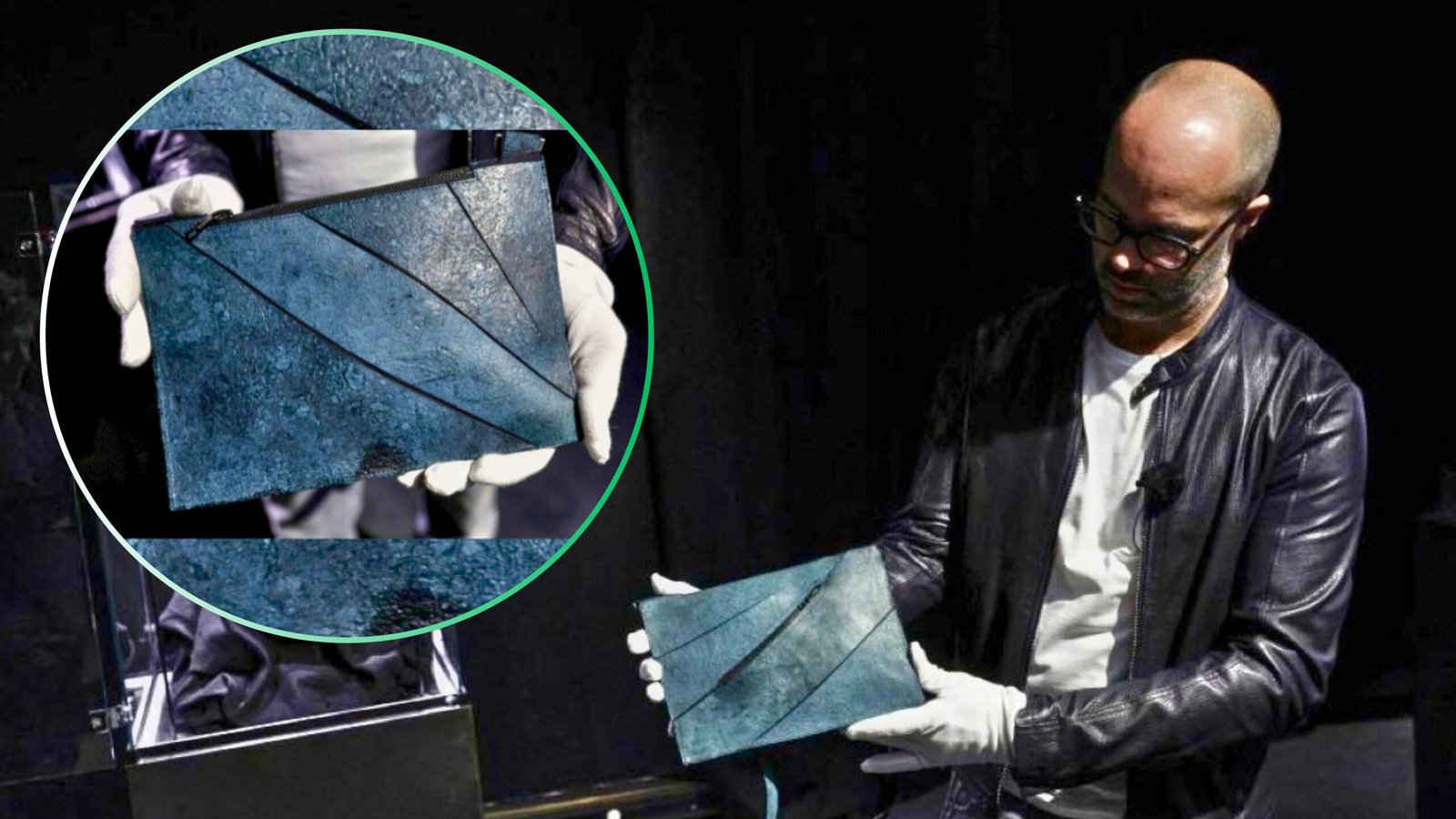
A handbag made from what its creators called “lab-grown T. rex leather” failed to sell at an auction in Paris on Thursday, 11 June 2026. The bag, which was earlier unveiled at the Artis Zoo Museum in Amsterdam beside a large dinosaur skeleton, received bids far below expectations.
Auction house Drouot said bids barely crossed $150,000 while auctioneers Giquello had expected the handbag to fetch more than $500,000.
According to the project’s producers, this so-called “T. rex leather” traces its origins to a Tyrannosaurus rex skeleton discovered in Montana around 20 years ago.
Paleontologist Mary Higby Schweitzer later claimed her team found soft tissue remains and protein fragments inside the fossilized bones, a finding that remains controversial among scientists.
The handbag material was developed using data from that discovery. According to Thomas Mitchell and Ernst Wolvetang of The Organoid Company, scientists used AI to reconstruct a complete protein sequence from the fragments.
Researchers largely based the reconstructed sequence on chicken proteins because birds are the closest living relatives of dinosaurs.
Jan Dekker, a postdoctoral researcher at the University of Turin who specializes in paleoproteomics, questioned the dinosaur connection, saying that dinosaur proteins remain highly controversial
Dekker said proteins are unlikely to survive for more than 20 million years in exceptional conditions, while T. rex disappeared about 66 million years ago. He added that even if the original fragments came from T. rex, around 90% of the final protein sequence would still come from chicken.
“What they have done is create synthetic collagen using an AI model trained on a variety of different species, mainly chicken. A very interesting development in itself, but it is not a dinosaur. In fact, it’s more chicken than anything else.”
– Jan Dekker, Postdoctoral Researcher, University of Turin
The project’s producers said lab grown leather has struggled to gain acceptance in the luxury market.
Bas Korsten of advertising agency VML said the team chose the T. rex concept because dinosaurs continue to fascinate people worldwide.
Dekker said he would not describe the material as “T. rex leather” from a scientific perspective. He noted that the material was created using synthetic collagen and AI-generated protein sequences, with most of the reconstructed protein based on chicken rather than dinosaur data.