
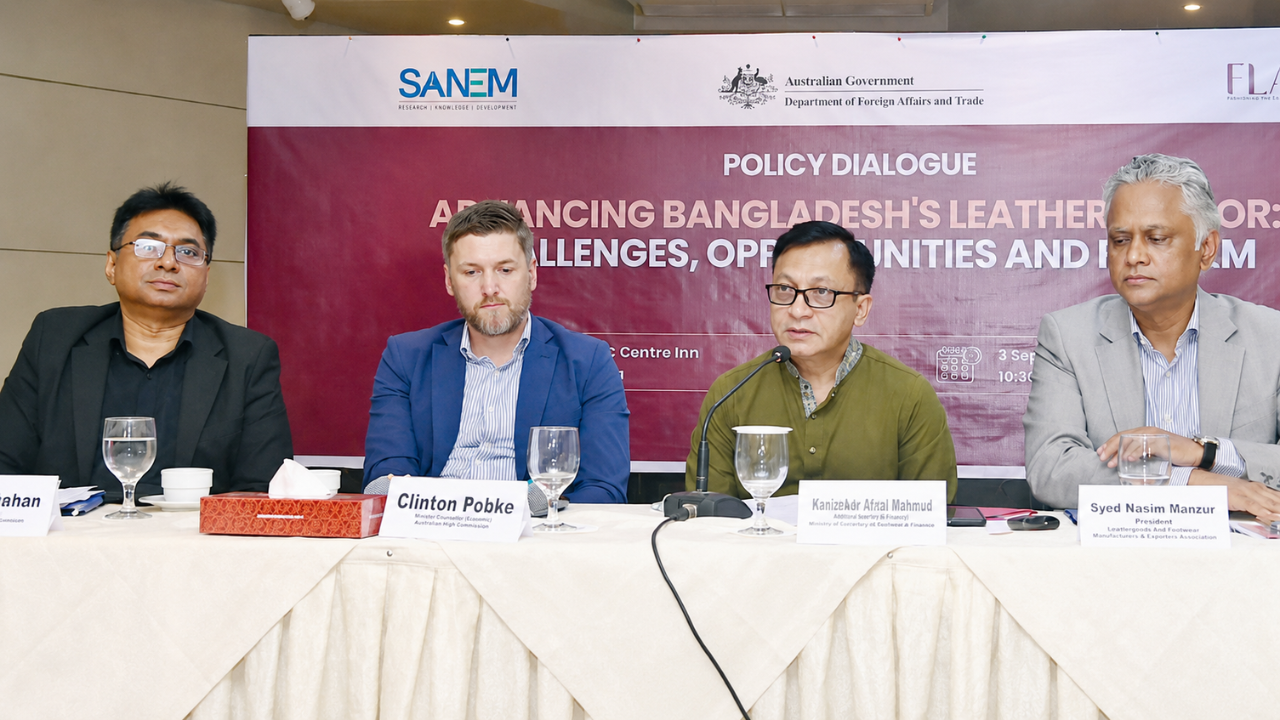
Bangladesh aims to build its leather and footwear industry into a $5 billion export sector by 2030 but achieving that target will require major improvements in environmental compliance, infrastructure and regulatory processes industry leaders said at a policy dialogue titled “ADVANCING BANGLADESH’S LEATHER SECTOR: CHALLENGES, OPPORTUNITIES AND REFORM” organised by the South Asian Network on Economic Modeling (SANEM) and the Footwear Leathergoods and Accessories Exporters Association (FLAXA) in Dhaka on September 3, 2026.
One of the biggest challenges remains the Savar tannery estate particularly its Central Effluent Treatment Plant (CETP). The facility was originally designed to treat 25,000 cubic metres of liquid waste per day but is currently estimated to handle only around 14,000 to 18,000 cubic metres.
The government has announced plans to develop a new CETP while also improving the existing facility. Under the proposed reforms, larger tanneries would eventually be expected to operate their own effluent treatment plants while smaller manufacturers would continue relying on the central system.
Commerce and Industry Minister Khandaker Abdul Muktadir said tanneries operating in the future would need to meet full compliance requirements and obtain Leather Working Group (LWG) certification.
The minister also said Bangladesh will seek duty free access to Japan for both leather and non-leather products, adding that leather has been included in Japan’s main negotiation category. South Korea already offers zero duty access for these products, he said.
The government also plans to simplify customs and bond related procedures and encourage Spanish and Italian companies to invest in the Savar tannery estate.
A design and skills institute is also planned near Hemayetpur. The institute will be jointly managed by the government, industry and an international partner and is expected to start operations in 2027.
Bangladesh exported around $1.76 billion worth of leather, footwear and leather products to more than 105 countries in FY2025-26 but the industry continues to lose potential value through exports of semi-processed leather.
According to a policy paper by the South Asian Network on Economic Modeling (SANEM) more than 65% of the country’s leather is exported as crust leather.
The study also identified environmental compliance, weak coordination among government agencies, inadequate monitoring, skills shortages, limited product diversification and difficulties in obtaining international certifications as major barriers to growth.
Industry representatives also pointed to gas shortages, poor infrastructure, expensive solid waste management and complicated licensing procedures as barriers to investment and growth.
The discussions also highlighted that reaching the country’s $5 billion export target will depend not only on fixing the Savar CETP but also on wider reforms that improve compliance, simplify regulations and encourage more value-added production within Bangladesh.