
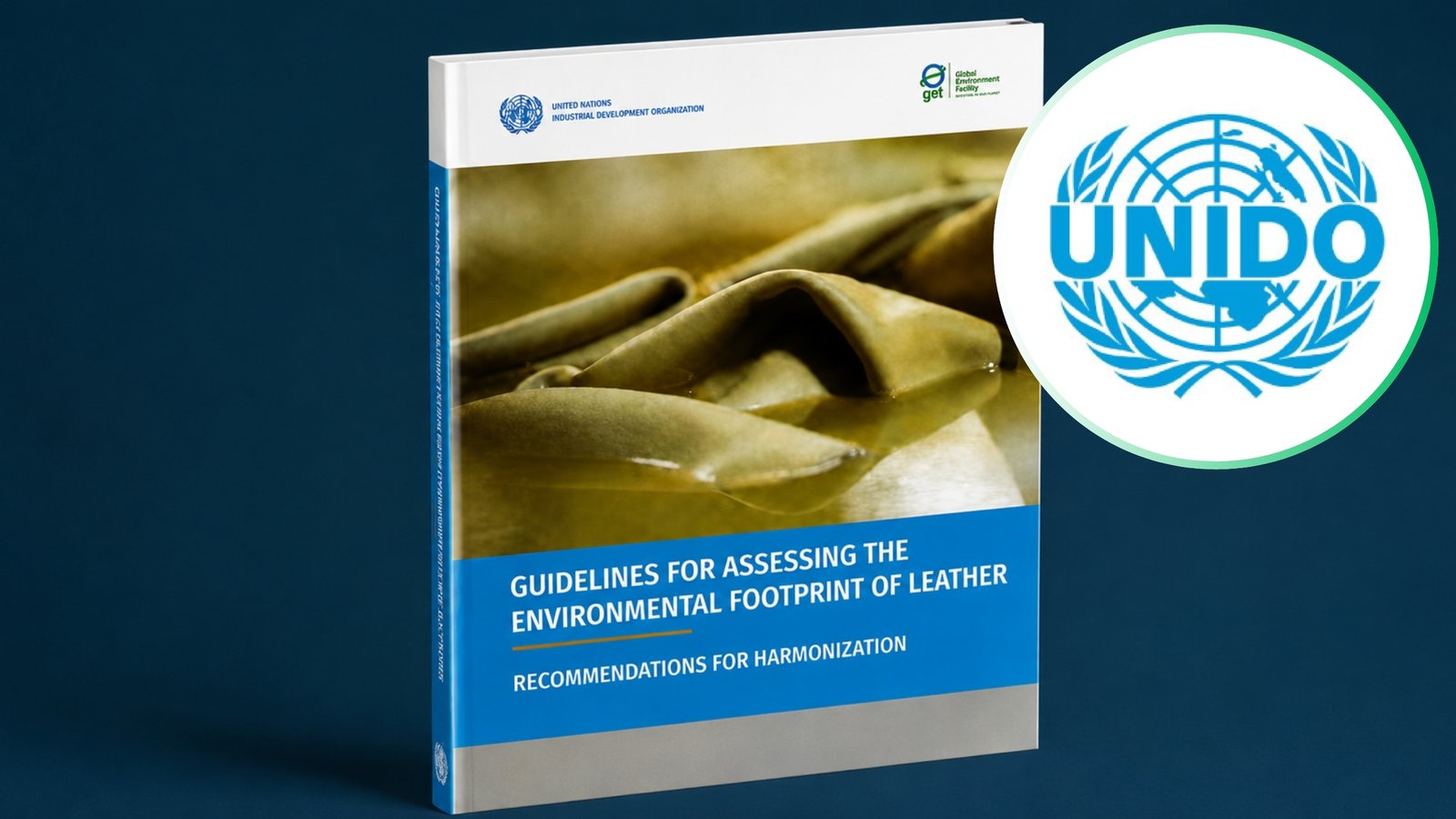
The United Nations Industrial Development Organization (UNIDO) has released new Guidelines for Assessing the Environmental Footprint of Leather, providing what they describe as a harmonized and scientifically grounded approach for calculating the environmental impact of leather across the value chain.
The publication was prepared under the guidance of Ivan Kral, Head of the Rural Development, Agro-Industries & Industrial Parks Unit at UNIDO and delivered by SPIN 360 led by Federico Brugnoli, with contributions from a 55 member advisory group representing the international leather industry across 16 countries.
The group included a diverse range of stakeholders such as brands, tanneries, chemical companies, universities, NGOs and representatives from other industrial sectors. The guidelines were developed over nearly 2 years.
According to UNIDO, the guidelines were developed to address growing interest in Product Environmental Footprint (PEF) and Product Carbon Footprint (CFP) calculations within the leather value chain. While several Product Category Rules (PCRs) and environmental assessment frameworks already exist, the document notes that current approaches still lack a fully harmonized and standardized methodology.
As a result, environmental footprint calculations can be difficult for 3rd parties to assess and are often not easily comparable across products. The guidelines aim to improve transparency, consistency and credibility in environmental reporting throughout the leather industry.
One of the most significant conclusions in the document is the classification of hides and skins from animals slaughtered for human food consumption as “Non-Determining Animal By-Products.”
According to the guidelines, these materials result from a multifunctional process and do not influence livestock production volumes. The document therefore concludes that such hides and skins are not drivers of environmental change.
The guidelines also introduce the concept of “Environmental Amortization,” a broader approach to assessing the environmental footprint of materials by considering technical performance and product lifespan.
The document also highlights the value of leather as a bio-based material and provides guidance on incorporating agricultural carbon removals into environmental footprint assessments.
ALSO READ: Red Wing Shoe Company Diverts 1.87 Million Pounds of Leather Waste from Landfill
The guidelines identify methodological opportunities within ISO 14067, ISO 14068 and SBTi FLAG frameworks that allow reforestation activities and biogenic carbon removals to be considered when calculating greenhouse gas removals.
A major objective of the document is the harmonization of Life Cycle Assessment (LCA) methodologies used throughout the leather industry.
The guidelines establish recommendations for 8 key elements: product system, functional unit and reference flow, system boundaries, allocation rules and procedures, life cycle impact assessment methodology and types of impact, reporting criteria, etc.
For each of these elements, the document reviews existing standards and Product Category Rules before providing recommendations and supporting justifications.
The publication also introduces recommendations on allocation methodologies used in environmental footprint calculations.
In cases where primary data is unavailable at the slaughterhouse stage, the guidelines provide global average values that may be adopted.
These include an Economic Allocation value of 1.50%, a Mass Fraction value of 7.33% and an Allocation Ratio of 0.205
ALSO READ: LHCA and CLIA Present Interim Leather LCA and Carbon Footprint Accounting Results
Beyond methodology, the report provides an updated overview of the global leather industry, including livestock trends, raw material availability, tanning production, market flows and leather applications.
The document highlights the need for improved data updates, particularly regarding the gap between globally available hides and skins and the volumes processed by the international tanning industry.
ALSO READ: Leather Leaders Project Brings Data Driven Shift to Global Leather Industry at APLF 2026
UNIDO states that growing sustainability expectations worldwide have increased demand for consistent, transparent and verifiable environmental data.
The organization believes that harmonized assessment methods can help improve comparability across materials and strengthen confidence in environmental claims.
The full Guidelines for Assessing the Environmental Footprint of Leather are available for readers who wish to explore the methodology, recommendations, market data and technical findings in greater detail.