
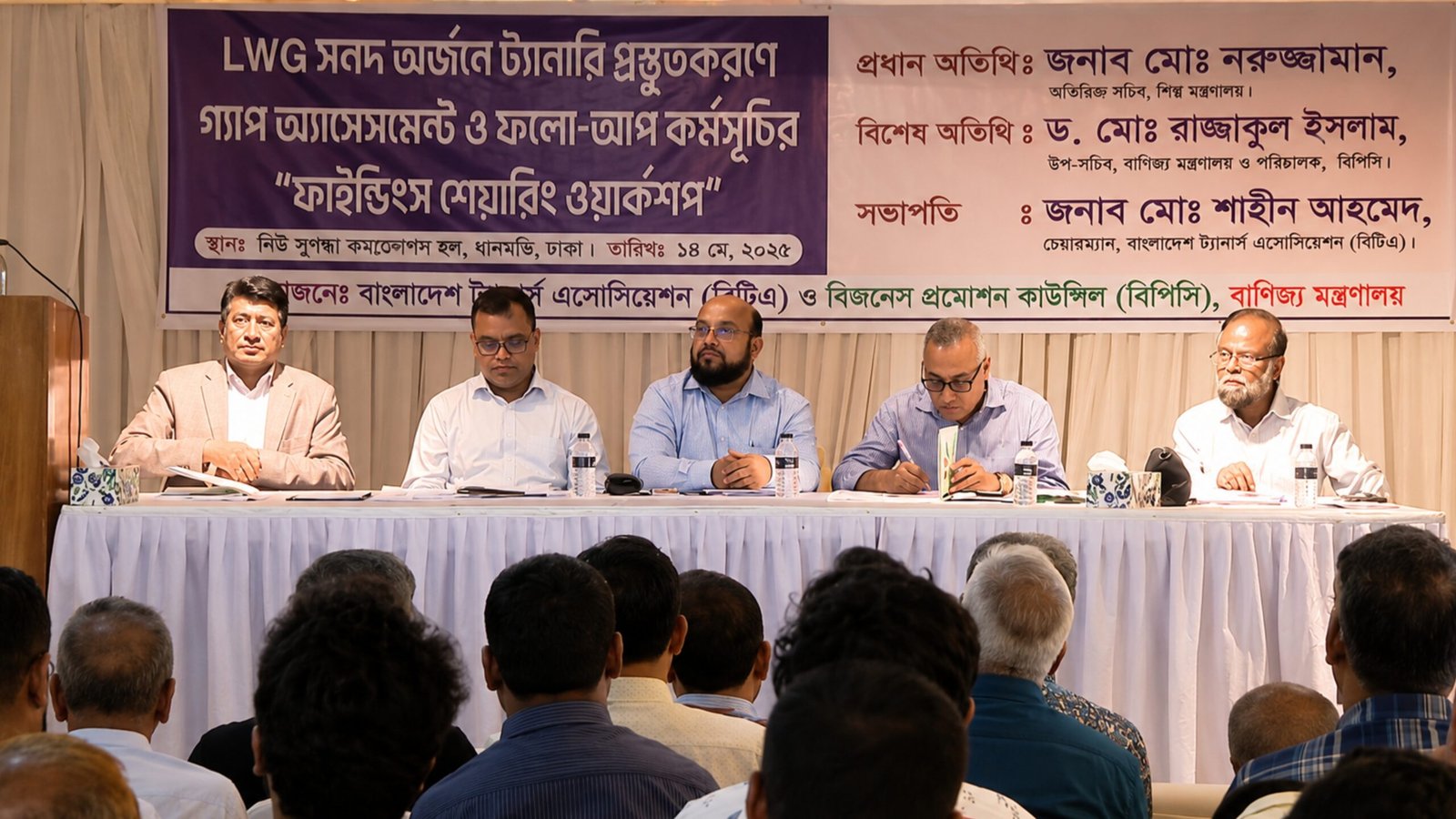
A recent audit of 20 tanneries in the Savar Tannery Industrial Estate found that most units are still far from meeting international standards under the Leather Working Group (LWG) protocol, limiting Bangladesh’s access to global leather markets. The findings were shared at a workshop held on 13 May reports The Business Standard
The audit, conducted in the current fiscal year, showed that only 3 tanneries scored above 50%, with the highest score reaching just 51%. 6 tanneries scored above 40% while the remaining units performed poorly.
The workshop, titled “Gap Assessment and Follow-up Programme Findings Sharing Workshop on Tanneries Preparedness for LWG Certification,” was jointly organised by the Bangladesh Tanners Association (BTA) and the Business Promotion Council (BPC).
Additional Secretary of the Ministry of Industries Md Nuruzzaman attended as chief guest while BTA President Md Shaheen Ahmed chaired the event.
Sustainable Leather Expert Md Afzal Hossain said tanneries need major improvements in occupational health and safety, emergency preparedness, waste management and pre-treatment systems to qualify for LWG certification.
ALSO READ: Bangladesh Government Fixes Raw Hide and Skin Prices Ahead of Eid-ul-Azha 2026
He said 300 out of the total 1,710 LWG points are linked to CETP and waste management, where Savar tanneries remain weak.
He also recommended water use tracking, monitoring treated wastewater discharge, safer chemical use, forming skilled technical teams, using at least 10% renewable energy, mechanical desalting and soak liquor separation for salt recovery.
The report identified Savar’s Central Effluent Treatment Plant (CETP) as only partially functional.
Only 8 organizations currently hold LWG certification. Around 140 of the 162 allocated tanneries in Savar are operational, but most cannot directly export to Europe and the US due to missing certifications. As a result, many sell raw hides and skins to China at lower prices, where it is processed and re exported to high value markets.
Md Nuruzzaman said replacing the CETP immediately is not possible as a new plant would take 2 to 3 years to build. He added that the government is upgrading the current CETP, planning a 2nd plant and considering loans for non-compliant tanneries to install individual ETPs.
Business Promotion Council Director Md Razzaqul Islam said Bangladeshi firms receive only one-third of potential global leather prices due to the absence of LWG certification.
BTA President Md Shaheen Ahmed said entrepreneurs have invested around Tk10,000-Tk12,000 crore in Savar, but the lack of a fully functional CETP continues to block access to global markets. He also said poor salt use and storage during Eid-ul-Azha reduce leather quality and prices while urging water metering, solar energy use and solid waste conversion to improve competitiveness.